Definition
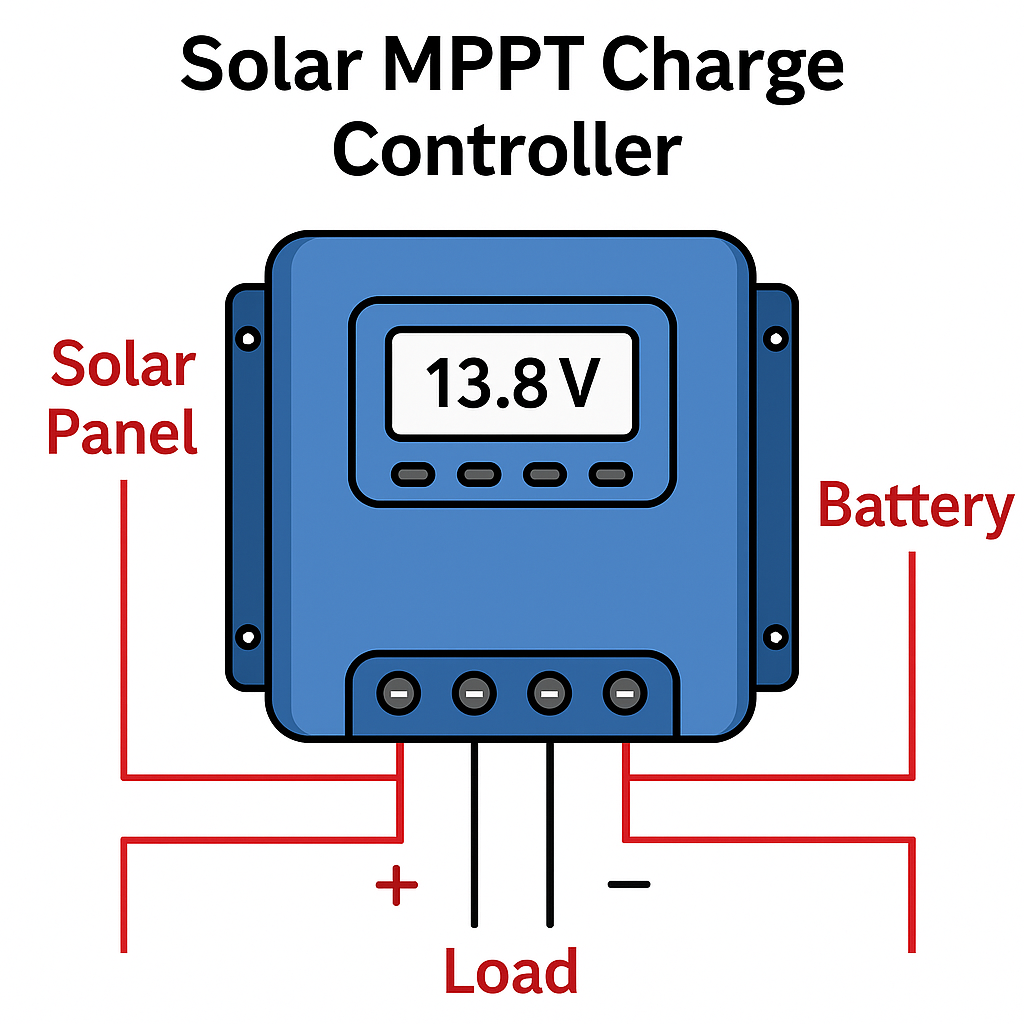
Working (How MPPT Works) of Solar MPPT Charge Controller
Solar panels have a nonlinear V-I characteristic and a distinct P-V (power versus voltage) curve. The MPP varies with irradiance (sunlight intensity), cell temperature and the load. An MPPT controller performs two primary tasks:
- It measures panel voltage and current and estimates the power output.
- It adjusts its internal DC–DC converter ratio (like a buck or buck-boost) to set the panel operating voltage close to the instantaneous MPP.
Internally, the MPPT uses an algorithm (examples below) to perturb the operating point and observe whether panel power increases or decreases. If power rises, the algorithm continues in the same adjustment direction; if it falls, the algorithm reverses. Modern MPPTs may use advanced techniques (adaptive perturbation, neural nets, or model-based control) to track faster and with less oscillation.
Common control algorithms
- Perturb & Observe (P&O) — simple, widely used. It tweaks voltage and checks if power improves.
- Incremental Conductance (IncCond) — compares incremental changes in current and voltage to compute the MPP more accurately under rapidly changing conditions.
- Constant Voltage / Lookup — uses pre-calculated MPP for known conditions; simpler but less flexible.
Efficiency & Heat
MPPT controllers are typically high efficiency devices (often 95%–99%). They dissipate less heat than inefficient linear regulators because most energy conversion uses switching topologies (buck, boost, synchronous converters) rather than dropping voltage as heat. However, significant power levels still require thermal design — heatsinks or forced-air cooling — especially in large systems.
Types of MPPT Charge Controllers
MPPT controllers can be categorized by converter topology and features. The table below compares the common types.
| Type | Topology / Notes | Advantages | Disadvantages |
|---|---|---|---|
| Synchronous Buck MPPT | High-efficiency buck converter using MOSFETs on both switches. | Very high efficiency <98%, low conduction losses, compact. | More complex gate drive, slightly higher BOM cost. |
| Non-isolated Boost/Buck-Boost | Allows panel voltage to be higher or lower than battery (buck-boost). | Flexible for varied PV and battery voltages; wide input range. | No galvanic isolation — must follow safety rules for DC circuits. |
| Isolated Converter (e.g., flyback) | Isolated topology provides galvanic isolation between PV and battery. | Increased safety and isolation; useful in specialized setups. | Lower efficiency at small sizes, more expensive, heavier. |
| Hybrid / Integrated Inverter-MPPT | Merges MPPT stage with inverter for AC output (off-grid/hybrid systems). | Simplifies system design; compact for off-grid installations. | Complex device; repair is more costly; initial cost higher. |
Advantages of Solar MPPT Charge Controller
- Higher energy harvest: MPPT typically yields 10%–30% more energy than PWM in many conditions (cloudy, cold panels, or systems with voltage mismatch).
- Voltage matching: Allows panels to operate at their optimal voltage while charging lower-voltage batteries efficiently.
- Better cold-weather performance: At low temperatures, panel voltage rises; MPPT can take advantage of higher MPP voltage to increase power.
- Flexibility: Supports longer strings or higher open-circuit voltages safely for a given battery voltage when topology allows.
Disadvantages of Solar MPPT Charge Controller
- Higher cost: MPPT controllers are more expensive than simple PWM controllers.
- Complexity: Firmware/algorithm complexity requires proper testing and quality design.
- Heat & EMI: Switching converters generate noise and heat that must be managed.
Applications of Solar MPPT Charge Controller
Common uses:
- Rooftop and ground-mounted solar systems charging 12V, 24V, 48V batteries.
- Off-grid solar power systems for homes, cabins, telecoms, and remote instrumentation.
- Solar-powered vehicles, boats, and mobile systems where space and efficiency matter.
Industry & commercial:
- Large-scale PV string inverters include MPPT stages to maximize array output.
- Hybrid systems use MPPT together with battery management and inverters for smart microgrids.
Selection & Practical Tips
- Choose MPPT rated for your PV open-circuit voltage (Voc) and maximum input current with margin for hot/cold extremes.
- Match battery chemistry profiles (lead-acid, Li-ion) — many MPPTs provide selectable charge algorithms.
- Consider environmental rating (IP65/67) for outdoor installations.
- Plan for adequate heat dissipation and wire sizing to minimize losses.
Maintenance & Troubleshooting
Keep PV connectors clean and secure, monitor the MPPT display for input/output voltages, and check firmware updates for smart controllers. For transient errors, verify VOC and battery voltages; check connections and fuses.