Definition
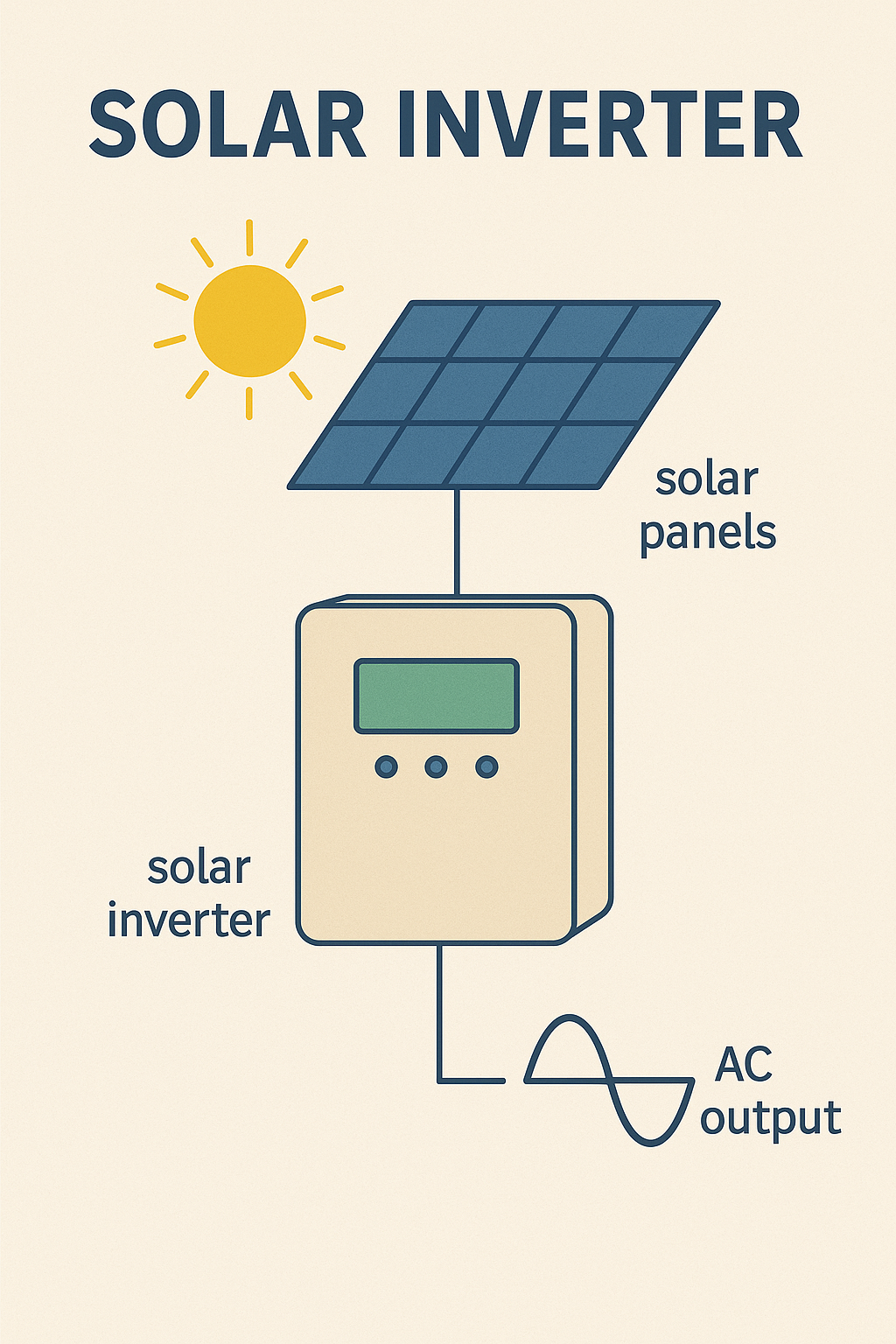
A solar inverter is an electronic device that converts the direct current (DC) generated by photovoltaic (PV) solar panels into alternating current (AC) that can be used by household appliances or exported to the electrical grid. Inverters typically also provide protective functions, system monitoring, and sometimes maximum power point tracking (MPPT) to optimize energy harvest from the solar array.
Working of Solar Inverter
At its core, a solar inverter performs three jobs:
- Convert DC to AC: Photovoltaic panels produce DC. The inverter uses power electronic switches (IGBTs or MOSFETs) to synthesize an AC waveform at the required voltage and frequency (e.g., 230 V, 50 Hz or 120 V, 60 Hz).
- Regulate and synchronize: For grid-connected systems, the inverter ensures the AC it generates is phase-locked and synchronized in voltage and frequency with the grid before exporting power.
- Optimize power extraction: Many inverters include MPPT controllers — algorithms that continuously adjust operating voltage/current so the PV array operates at its maximum power point under varying sunlight and temperature.
Working (step-by-step)
The physical flow is:
- Sunlight → PV cells produce DC current and voltage.
- DC flows to inverter input; MPPT stage finds the best voltage/current for maximum power.
- Power electronic stage chops and reconstructs an AC sine (or high-quality modified sine) output.
- AC is filtered and stepped up/down (if required) and sent to loads or grid.
- In case of grid failure, grid-tied inverters disconnect for safety; hybrid inverters may switch to island mode supporting backup loads.
Types of Solar Inverter
Selection checklist — what to consider when buying
- System size and peak power (kW) — choose an inverter whose AC rating matches load and PV array.
- Grid compatibility — voltage, frequency and anti-islanding certifications required by local utilities.
- MPPT trackers — number of MPPT inputs matters for arrays with differing orientations.
- Battery compatibility — if planning storage, confirm battery chemistry and bidirectional capabilities.
- Warranty & service — inverter warranties range 5–12 years; extended options are common.
Safety & maintenance
Always install through certified electricians and follow local regulations. Typical maintenance: keep vents clean, ensure firmware updates, monitor performance dashboards and test safety disconnects annually.
Difference between Solar Inverter and Normal Inverter
| Criteria | Solar Inverter | Normal (Standard) Inverter |
|---|---|---|
| Primary purpose | Converts DC from solar panels to AC, often with MPPT and grid-synchronization features. | Converts DC (usually from batteries or DC source) to AC to power appliances; not designed to handle PV input directly. |
| Input source | Photovoltaic arrays (DC) — variable voltage and current depending on irradiance. | Battery bank or stable DC source with relatively steady voltage (e.g., 12V/24V/48V). |
| MPPT (Maximum Power Point Tracking) | Usually built-in (essential) to maximize energy harvest from PV under changing sun and temperature. | Typically not present. Some advanced battery inverters may include charge controllers separately. |
| Grid interaction | Most solar inverters support grid-tied operation with synchronization, anti-islanding and feed-in capabilities. | Standard inverters (off-grid type) do not synchronize with grid; they supply isolated loads. UPS/online inverters may interface with grid in specific systems. |
| Output waveform & quality | High quality pure sine (for grid-tied and modern models). Designed to meet utility standards (THD, frequency). | Varies — cheap models may output modified sine; good models output pure sine but usually optimized for battery use. |
| Safety & standards | Comes with PV-specific protections: anti-islanding, DC surge protection, PV string isolation and sometimes DC disconnects; needs grid certifications. | Has protections for load and batteries (overload, short circuit, low battery shutdown), but lacks PV-specific protections. |
| Use with batteries | Some are hybrid (battery-ready) with built-in charge controllers and battery management; others (grid-only) require separate battery inverters/chargers. | Designed primarily to work with batteries; many include battery chargers and transfer switches for generator/grid integration. |
| Typical applications | Residential/commercial PV systems, solar-plus-storage, grid-feed installations, utility scale (central/string inverters). | Backup power via batteries, RVs, boats, off-grid electrification (when paired with charge controller and PV indirectly). |
| Efficiency | High peak efficiency (often 95–98%) with MPPT improving real-world energy yield from PV. | Efficiency depends on design; good units also reach ~90–95% but no MPPT benefits for PV input. |
| Typical lifetime | 8–15 years (electronics/thermal stress); warranties often 5–10+ years for grid-tied models. | 8–12 years typical for heavy-duty battery inverters; consumer models depend on use and ventilation. |
| Cost | Usually higher due to MPPT, grid certifications, monitoring and PV-specific protections. | Varies widely — simple consumer inverters are cheaper; high-end pure sine battery inverters can be comparable in price. |
| When to pick one over the other? | Choose a solar inverter when connecting PV panels — needed features: MPPT, grid sync, PV protections. | Choose a normal inverter for pure battery-to-AC backup or portable power where PV integration is not required. |
Solar Inverter – Working Principle, Types, Construction, Advantages and Applications
A complete guide to solar inverter technology, DC-to-AC conversion, MPPT, circuit operation, electrical formulas, efficiency and practical calculations.
A solar inverter is an important power electronic device used in photovoltaic (PV) systems. It converts the direct current (DC) electricity generated by solar panels into alternating current (AC) electricity that can operate household appliances, industrial equipment and other electrical loads.
Solar panels generate DC power, whereas most electrical appliances and utility distribution systems use AC power. Therefore, an inverter is required to make solar-generated electricity compatible with the electrical system. Depending on its design, a solar inverter may also perform maximum power point tracking (MPPT), battery charging, grid synchronization, monitoring and electrical protection.
Solar inverters are commonly used in residential rooftop systems, commercial buildings, solar farms, agricultural installations and standalone power systems.
1. What Is a Solar Inverter?
A solar inverter is an electronic power conversion device that changes DC electricity from a photovoltaic array or battery into AC electricity. It uses semiconductor switching devices, such as MOSFETs and IGBTs, to produce an alternating output waveform.
In a grid-connected installation, the inverter also synchronizes its output with the utility supply. It controls output voltage, frequency and phase, and includes protection functions required for safe grid operation.
In a standalone installation, the inverter generates its own AC voltage and frequency to supply connected loads. A battery is generally used to store energy for operation when solar generation is insufficient.
2. Construction and Main Components of a Solar Inverter
A modern solar inverter contains several electronic circuits and protection devices. Their arrangement depends on whether the system is grid-connected, off-grid or hybrid.
1. DC Input Section
Receives DC electricity from the solar PV array. It includes input terminals, connectors, isolation and protection components.
2. MPPT Controller
Tracks the maximum power point of the PV array and adjusts its operating voltage to extract available solar power.
3. DC-DC Converter
Changes the DC voltage to a suitable level for the inverter DC link. Some designs integrate this function with the MPPT stage.
4. DC Link Capacitor
Maintains a relatively stable DC bus voltage and reduces voltage fluctuations between conversion stages.
5. Switching Circuit
Uses MOSFETs or IGBTs to switch DC power and synthesize an alternating output waveform.
6. Output Filter
Uses inductors and capacitors to reduce switching-frequency harmonics and improve output waveform quality.
7. Control Unit
A microcontroller or digital signal processor manages switching, MPPT, synchronization and system monitoring.
8. Protection System
Monitors faults such as overvoltage, overcurrent, overheating, insulation problems and grid abnormalities.
Functions of Main Components
| Component | Function |
|---|---|
| PV input | Receives DC power from solar panels |
| MPPT controller | Optimizes solar power extraction |
| DC-DC converter | Regulates or boosts DC voltage |
| DC link capacitor | Stabilizes the DC bus |
| MOSFET / IGBT | Performs high-speed electronic switching |
| Output filter | Reduces switching harmonics |
| Controller | Controls the complete conversion process |
| Cooling system | Removes heat from power components |
3. Working Principle of Solar Inverter
The working principle of a solar inverter is based on electronic DC-to-AC conversion. Photovoltaic panels generate DC electricity when exposed to sunlight. The inverter receives this power, regulates it and uses electronic switching circuits to produce AC electricity.
Step 1: Solar Energy Generation
Solar cells convert sunlight into electrical energy through the photovoltaic effect. The cells are connected in series and parallel to form solar modules and arrays. Their output voltage and current depend on sunlight intensity, temperature and electrical loading.
Step 2: Maximum Power Point Tracking
The MPPT controller continuously adjusts the PV operating point to obtain maximum available power. It uses electrical measurements and a control algorithm to find the optimum voltage and current.
Step 3: DC Voltage Regulation
The DC-DC conversion stage adjusts the voltage when required. A boost converter may increase a lower PV voltage to the required DC-link voltage. Not all inverter architectures require a separate boost stage.
Step 4: DC-to-AC Conversion
The inverter bridge switches semiconductor devices in a controlled sequence. By changing the switching pattern, it produces a voltage that alternates between positive and negative values. Pulse Width Modulation (PWM) is commonly used to synthesize a sinusoidal output.
Step 5: Filtering and AC Output
The output filter reduces unwanted high-frequency switching components. The resulting AC electricity is supplied to the connected load or, in a grid-connected system, synchronized with the utility supply.
Step 6: Monitoring and Protection
The control unit monitors the DC input, AC output, temperature, current, voltage and operating conditions. If a fault is detected, the inverter may reduce output or disconnect according to its protection design.
4. Animated Working Diagram of Solar Inverter
The following animated diagram illustrates the basic energy conversion process in a solar PV system. The moving particles represent the direction of energy flow, not individual electrons.
Solar Inverter – Power Flow Animation
Sunlight to PV generation to DC conversion to AC electrical load
Grid-connected systems also include synchronization, grid protection and a suitable AC connection. Battery connections are application-dependent.
5. Types of Solar Inverters
Solar inverters are classified according to their circuit arrangement, connection method and energy storage capability.
5.1 String Inverter
A string inverter receives DC electricity from a group of solar panels connected in series. It converts the combined DC output into AC electricity. String inverters are widely used in residential and commercial rooftop installations.
They are generally economical and relatively simple to maintain. However, shading or mismatch between modules in the same string can affect overall system performance.
5.2 Microinverter
A microinverter is a small inverter installed at each solar panel or module. Each unit independently converts its connected panel’s DC output into AC electricity.
This arrangement can reduce the impact of partial shading between different panels and provides module-level monitoring. The initial system cost may be higher.
5.3 Central Inverter
A central inverter is a large-capacity unit that converts power from multiple PV strings or arrays. It is commonly used in utility-scale solar power plants and large installations.
5.4 Off-Grid Solar Inverter
An off-grid inverter operates independently of the utility grid. It generally works with a battery bank and supplies AC power to loads when required. Solar energy can charge the battery during daylight hours.
5.5 On-Grid Solar Inverter
An on-grid inverter synchronizes its AC output with the utility grid. Solar electricity is first used by connected loads when the system is arranged for self-consumption, and surplus energy may be exported under the applicable interconnection and metering arrangement.
5.6 Hybrid Solar Inverter
A hybrid inverter combines solar power conversion and battery management functions. Depending on its design, it can supply loads from solar energy, charge a battery, use grid power and provide backup power through a designated output.
5.7 Battery Inverter
A battery inverter converts battery DC power into AC electricity. Bidirectional models can also convert AC electricity into DC for charging the battery.
Comparison of Solar Inverter Types
| Type | Battery | Main Application | Key Feature |
|---|---|---|---|
| String | Optional / external | Home and commercial PV | Centralized string conversion |
| Microinverter | Not normally required | Residential PV | Panel-level conversion |
| Central | System-dependent | Solar power plants | High power capacity |
| Off-grid | Usually required | Remote locations | Independent operation |
| On-grid | Not normally required | Grid-connected PV | Grid synchronization |
| Hybrid | Supported | Solar with backup | PV and battery integration |
| Battery inverter | Required | Energy storage | Battery charge and discharge |
6. DC to AC Conversion in a Solar Inverter
The DC-to-AC conversion stage is the central operation of an inverter. It commonly uses a full-bridge or H-bridge arrangement containing four controlled semiconductor switches.
In a simplified single-phase H-bridge, diagonal switch pairs are activated alternately to reverse the polarity across the load. PWM control changes the switching duration to approximate the desired AC waveform.
Basic AC Voltage Equation
An ideal sinusoidal AC voltage can be represented by:
Where:
- \(v(t)\) = instantaneous voltage in volts
- \(V_m\) = peak voltage in volts
- \(f\) = frequency in hertz
- \(t\) = time in seconds
- \(\phi\) = phase angle
For a pure sinusoidal waveform, RMS voltage is:
For example, an ideal 230 V RMS sinusoidal supply has a peak voltage of approximately 325.3 V.
7. Maximum Power Point Tracking (MPPT)
Maximum Power Point Tracking is an important control function in many solar inverters. A PV module has a nonlinear current-voltage characteristic. Its output power changes with solar irradiance and cell temperature.
The maximum power point is the operating condition at which the product of PV voltage and current reaches its maximum value.
The maximum power point can be expressed as:
Common MPPT techniques include:
- Perturb and Observe (P&O): Changes the PV operating voltage slightly and observes whether power increases or decreases.
- Incremental Conductance: Uses the relationship between incremental conductance and instantaneous conductance to locate the maximum power point.
- Other digital control methods: Some systems use advanced algorithms for changing irradiance and partially shaded conditions.
MPPT does not create additional energy. It helps the system operate closer to the maximum power available from the solar array under the prevailing conditions.
8. Important Solar Inverter Formulas and Equations
8.1 DC Input Power
DC power is the product of input voltage and current. For example, a 400 V DC input carrying 10 A supplies 4000 W of DC power.
8.2 AC Single-Phase Power
Where \(\cos\phi\) is the power factor. For a purely resistive load, the power factor is approximately 1.
8.3 Three-Phase AC Power
Where \(V_L\) and \(I_L\) are line-to-line RMS voltage and line current respectively for a balanced three-phase system.
8.4 Inverter Efficiency
Inverter efficiency indicates the percentage of input DC power converted into usable AC output power.
8.5 Output Power
In this equation, efficiency must be expressed as a decimal. For example, 96% efficiency is represented as 0.96.
8.6 Power Loss
8.7 Battery Energy
This gives nominal energy in watt-hours when voltage is in volts and battery capacity is in ampere-hours. Actual usable energy depends on battery chemistry, permissible depth of discharge and operating conditions.
8.8 DC Input Current
8.9 Frequency and Time Period
For a 50 Hz supply, the period of one complete cycle is 0.02 seconds or 20 milliseconds.
8.10 Energy Consumption
Energy is measured in watt-hours when power is in watts and time is in hours. Divide by 1000 to convert watt-hours into kilowatt-hours.
9. Solar Inverter Efficiency Calculator
Enter DC voltage, DC current and inverter efficiency to calculate the AC output power and conversion losses.
Calculated Results
Illustrative calculation. Actual performance depends on operating conditions.
10. Solar Inverter vs Normal Inverter
A conventional inverter generally converts battery DC power into AC power. A solar inverter is designed to work with photovoltaic generation and may include MPPT, PV input protection and grid-interconnection functions.
| Parameter | Solar Inverter | Normal Inverter |
|---|---|---|
| Main input | Solar PV DC and sometimes battery | Usually battery DC |
| Main function | Solar DC-to-AC conversion | DC-to-AC conversion |
| MPPT | Available in many models | Not normally included |
| Grid synchronization | In grid-connected models | Depends on design |
| Battery support | Depends on inverter type | Commonly supported |
| Applications | Solar power systems | Backup power systems |
11. Advantages of Solar Inverter
- Renewable energy utilization: Makes solar-generated electricity usable for AC appliances.
- Reduced grid consumption: Solar electricity can supply local loads and reduce purchased energy.
- MPPT optimization: Helps extract available power from photovoltaic modules.
- Monitoring: Modern models can report generation, energy use and faults.
- Battery integration: Hybrid models can provide energy storage and backup capabilities.
- Flexible applications: Suitable for residential, commercial, industrial and utility-scale installations.
- Automatic operation: Electronic control manages conversion and operating conditions.
12. Disadvantages of Solar Inverter
- Initial cost: A quality inverter increases the initial cost of a solar installation.
- Conversion losses: DC-to-AC conversion is not 100% efficient.
- Temperature sensitivity: High operating temperatures can reduce output or trigger thermal protection.
- Electronic complexity: Advanced control circuits require skilled servicing.
- Limited service life: Electronic components may need repair or replacement during the life of the solar panels.
- Grid outage limitations: Standard grid-following inverters normally disconnect during outages unless a suitable backup system is installed.
13. Applications of Solar Inverter
Residential Solar
Converts rooftop PV electricity for household lighting, fans, appliances and other loads.
Commercial Buildings
Supports office buildings, shops, schools and other commercial solar installations.
Industrial Systems
Converts solar electricity for selected industrial loads and large PV installations.
Solar Power Plants
Used in large solar farms to convert photovoltaic DC output into grid-compatible AC power.
Rural Electrification
Provides AC power in remote locations through off-grid solar and battery systems.
Solar Battery Storage
Supports charging, discharging and energy management in solar-plus-storage systems.
14. How to Select a Solar Inverter
Selecting a suitable inverter requires consideration of the PV array, AC loads, battery requirements and electrical installation conditions.
Important Selection Factors
- Inverter rated power: Match the continuous AC output rating with the expected load and system design.
- PV input voltage: Check that the solar string’s operating and open-circuit voltages remain within the inverter’s specified limits under all expected temperatures.
- MPPT voltage range: Confirm that the PV array’s operating voltage fits the MPPT range.
- Maximum PV input current: Check the permissible current for every MPPT input.
- Battery compatibility: For hybrid or off-grid systems, verify battery voltage, chemistry and charging requirements.
- Efficiency: Compare conversion efficiency and performance at different load levels.
- Protection: Review overvoltage, overcurrent, temperature, short-circuit and anti-islanding protections as applicable.
- Warranty and service: Check the warranty, local technical support and availability of replacement parts.
15. Maintenance and Safety of Solar Inverters
Regular inspection helps maintain reliable inverter operation. Maintenance should follow the manufacturer’s instructions and be performed by qualified personnel.
- Keep the inverter’s ventilation openings clear.
- Check for unusual noise, overheating or fault indications.
- Monitor generation and operating data.
- Inspect accessible equipment for visible damage or moisture.
- Follow the prescribed inspection and maintenance schedule.
- Use suitable DC and AC isolation and protective devices.
- Never open an energized inverter or handle exposed DC conductors.
16. Frequently Asked Questions (FAQs)
1. What is a solar inverter?
A solar inverter is a power electronic device that converts DC electricity generated by solar panels into AC electricity for appliances, electrical systems or grid connection.
2. What is the working principle of a solar inverter?
It uses semiconductor switching devices to convert DC into AC. Its control circuit regulates the output waveform, while MPPT optimizes the solar panel operating point in supported systems.
3. What are the main components of a solar inverter?
Common components include DC input circuits, MPPT controller, DC-DC converter where applicable, DC-link capacitor, switching bridge, output filter, controller, cooling system and protection circuits.
4. What are the different types of solar inverters?
Common types include string, micro, central, on-grid, off-grid, hybrid and battery inverters.
5. What is MPPT in a solar inverter?
Maximum Power Point Tracking is a control technique that adjusts the PV operating voltage and current to obtain the maximum available solar power under changing conditions.
6. What is the efficiency of a solar inverter?
Efficiency is the ratio of AC output power to DC input power. The actual value varies with inverter design, operating load, temperature and input voltage.
7. Can a solar inverter work without a battery?
Yes. Many grid-connected solar inverters operate without batteries. Off-grid systems generally require energy storage or another suitable source to supply loads when solar generation is unavailable.
8. Does an on-grid solar inverter work during a power cut?
A conventional grid-following inverter disconnects during a utility outage for safety. Backup operation requires a compatible hybrid inverter or other approved backup arrangement.
9. What is the difference between an on-grid and off-grid inverter?
An on-grid inverter synchronizes with the utility grid. An off-grid inverter operates independently and generally uses a battery system to supply loads.
10. What is the function of an inverter filter?
The output filter reduces unwanted switching-frequency components and helps produce a smoother AC waveform.
11. Which switching devices are used in solar inverters?
MOSFETs and IGBTs are commonly used. The choice depends on power rating, voltage, switching frequency, efficiency and topology.
12. Why is solar inverter protection important?
Protection functions help prevent unsafe operation caused by abnormal voltage, current, temperature, grid conditions and other electrical faults.
17. Conclusion
A solar inverter is an essential component of a photovoltaic power system. It converts DC electricity generated by solar panels into AC electricity suitable for electrical appliances and grid-connected applications.
Its main functions include DC-to-AC conversion, maximum power point tracking, voltage regulation, grid synchronization and system protection. Different inverter types, such as string, micro, central, on-grid, off-grid and hybrid models, are designed for different applications.
Understanding the construction, working principle, electrical equations, efficiency and selection criteria of a solar inverter is important for electrical engineering students, technicians, designers and solar energy professionals.