A flux meter is an electrical measuring instrument used for determining the total magnetic flux linked with a magnetic material or a search coil. Unlike ordinary moving-coil instruments that measure steady current, a flux meter is specially designed to respond to very small currents produced due to a change in magnetic flux. It is widely used in laboratories, magnetic testing, transformer research, magnetic core studies and electrical machine experiments.
Flux Meter Diagram
The following diagrams illustrate the construction and working arrangement of a flux meter:
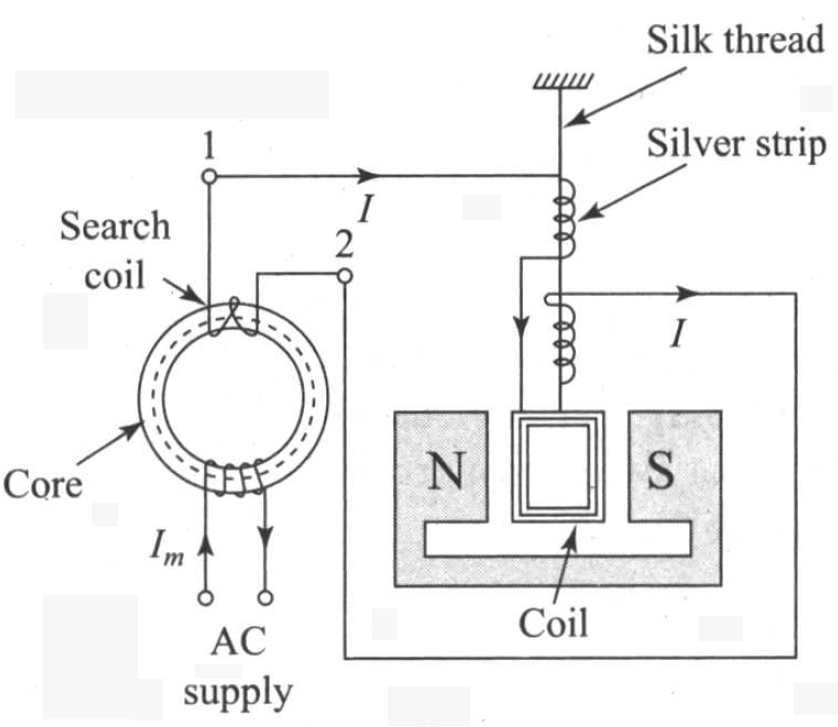
Figure 1: Flux Meter.
In the figure 1, a search coil is wound on a magnetic core that carries alternating flux. The coil of the flux meter is suspended in a weak control torque system using fine silver strips and a silk thread.
Definition of Flux Meter
A flux meter is a highly sensitive moving-coil instrument that measures magnetic flux by detecting the amount of charge flowing through its coil when a change in magnetic flux occurs in a connected search coil. The deflection of the meter pointer is directly proportional to the change in magnetic flux linked with the search coil.
Construction of Flux Meter
The construction of a flux meter is similar to a highly sensitive permanent magnet moving-coil instrument, but several modifications are made so that it can measure change in magnetic flux instead of current. The major constructional parts are:
- Permanent Magnet System – Produces a uniform magnetic field for the moving coil.
- Lightweight Moving Coil – Carries the measuring current coming from the search coil.
- Silk Thread Suspension – The coil is suspended with almost negligible restoring torque.
- Fine Silver Control Strips – Replace control springs to minimize control torque and damping.
- Search Coil (External) – Connected to the terminals of the flux meter and linked with the magnetic field.
- Pointer and Scale – Indicates the angular deflection proportional to change in flux.
The absence of strong control springs allows the coil to respond freely even to a very small induced current. This makes the flux meter extremely sensitive to magnetic flux variations.
Working Principle of Flux Meter
The working principle of a flux meter is based on electromagnetic induction and ballistic deflection. When the magnetic flux linking the search coil changes, an EMF is induced in the coil according to Faraday’s law of electromagnetic induction. This induced EMF produces a current that flows through the flux meter coil.
Because the instrument has very low control torque and resistance, the coil experiences a deflecting torque proportional to the total charge passed. Hence, the angular deflection of the pointer becomes proportional to the change in magnetic flux.
Working of Flux Meter (Step-by-Step)
- The search coil is placed over or around a magnetic specimen or core.
- When the magnetic flux in the specimen changes, an EMF is induced in the search coil.
- This induced EMF drives a small current through the flux meter coil.
- The moving coil experiences a torque and starts deflecting.
- The deflection stops once the flux becomes steady again.
- The final deflection reading is proportional to the total change in magnetic flux.
Therefore, the flux meter serves as an integrating instrument that measures the net change in flux rather than instantaneous flux density.
Mathematical Relationship
If φ is the change in flux and θ is the deflection, then:
where G is the proportionality constant and N is the number of turns of the search coil.
Types of Flux Meters
| Type | Description |
|---|---|
| Moving Coil Flux Meter | Traditional type based on mechanical deflection of a suspended coil. |
| Digital Flux Meter | Uses electronic circuits and digital integration for high-accuracy readings. |
| Vibrating Coil Flux Meter | Improved sensitivity using vibration-based detecting system. |
| Hall Effect Flux Meter | Uses Hall-effect sensors instead of a mechanical coil. |
| Portable Laboratory Flux Meter | Used in research labs and academic experiments. |
Advantages of Flux Meter
- Measures very small magnetic flux variations accurately.
- High sensitivity and negligible control torque.
- Uniform and linear scale reading.
- Can measure total flux or change in flux directly.
- Useful for transformer and magnetic material testing.
- Low power consumption.
- Can be used with shunt to increase measurement range.
Disadvantages of Flux Meter
- Mechanical construction is delicate and requires careful handling.
- Affected by external vibrations and shock.
- Cannot measure steady flux directly — only change in flux.
- Accuracy depends on uniform magnetic field conditions.
- Needs frequent calibration.
Applications of Flux Meter
- Measurement of magnetic flux in transformer cores.
- Testing of permanent magnets and magnetic circuits.
- Magnetic hysteresis and B-H loop experiments.
- Measurement of flux linkage in rotating machines.
- Calibration of electromagnetic instruments.
- Magnetic material research laboratories.
- Flux distribution analysis in electrical devices.
Conclusion
A flux meter is an essential instrument in the study and testing of magnetic systems. Its ability to measure very small variations in magnetic flux makes it highly valuable in electrical engineering laboratories, magnetic material testing, transformer development and research activities. With the advancement of technology, modern digital flux meters have further improved accuracy, resolution and ease of operation, while still being based on the same fundamental principle of electromagnetic induction.