Definition
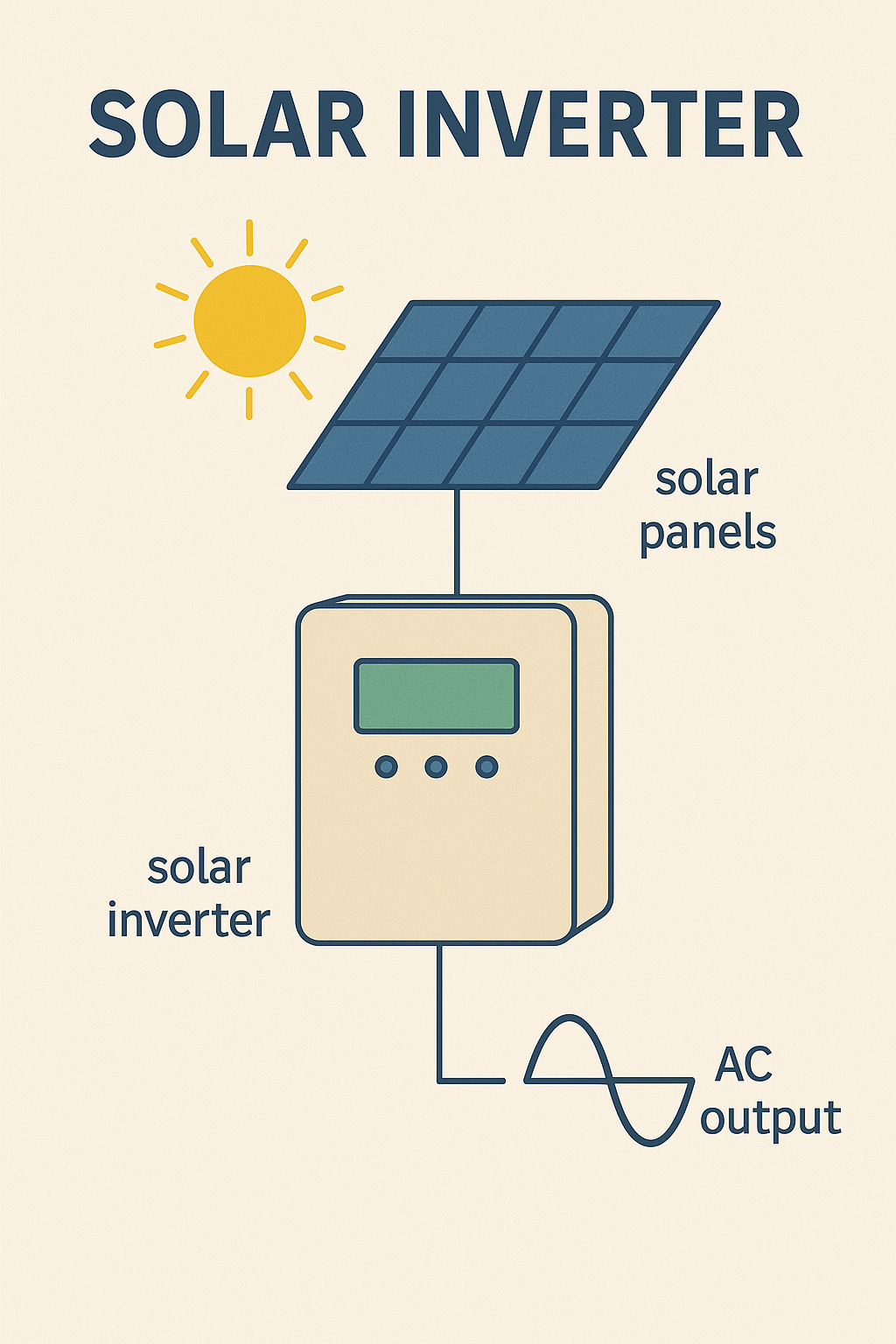
A solar inverter is an electronic device that converts the direct current (DC) generated by photovoltaic (PV) solar panels into alternating current (AC) that can be used by household appliances or exported to the electrical grid. Inverters typically also provide protective functions, system monitoring, and sometimes maximum power point tracking (MPPT) to optimize energy harvest from the solar array.
Working of Solar Inverter
At its core, a solar inverter performs three jobs:
- Convert DC to AC: Photovoltaic panels produce DC. The inverter uses power electronic switches (IGBTs or MOSFETs) to synthesize an AC waveform at the required voltage and frequency (e.g., 230 V, 50 Hz or 120 V, 60 Hz).
- Regulate and synchronize: For grid-connected systems, the inverter ensures the AC it generates is phase-locked and synchronized in voltage and frequency with the grid before exporting power.
- Optimize power extraction: Many inverters include MPPT controllers — algorithms that continuously adjust operating voltage/current so the PV array operates at its maximum power point under varying sunlight and temperature.
Working (step-by-step)
The physical flow is:
- Sunlight → PV cells produce DC current and voltage.
- DC flows to inverter input; MPPT stage finds the best voltage/current for maximum power.
- Power electronic stage chops and reconstructs an AC sine (or high-quality modified sine) output.
- AC is filtered and stepped up/down (if required) and sent to loads or grid.
- In case of grid failure, grid-tied inverters disconnect for safety; hybrid inverters may switch to island mode supporting backup loads.
Types of Solar Inverter
Selection checklist — what to consider when buying
- System size and peak power (kW) — choose an inverter whose AC rating matches load and PV array.
- Grid compatibility — voltage, frequency and anti-islanding certifications required by local utilities.
- MPPT trackers — number of MPPT inputs matters for arrays with differing orientations.
- Battery compatibility — if planning storage, confirm battery chemistry and bidirectional capabilities.
- Warranty & service — inverter warranties range 5–12 years; extended options are common.
Safety & maintenance
Always install through certified electricians and follow local regulations. Typical maintenance: keep vents clean, ensure firmware updates, monitor performance dashboards and test safety disconnects annually.
Difference between Solar Inverter and Normal Inverter
| Criteria | Solar Inverter | Normal (Standard) Inverter |
|---|---|---|
| Primary purpose | Converts DC from solar panels to AC, often with MPPT and grid-synchronization features. | Converts DC (usually from batteries or DC source) to AC to power appliances; not designed to handle PV input directly. |
| Input source | Photovoltaic arrays (DC) — variable voltage and current depending on irradiance. | Battery bank or stable DC source with relatively steady voltage (e.g., 12V/24V/48V). |
| MPPT (Maximum Power Point Tracking) | Usually built-in (essential) to maximize energy harvest from PV under changing sun and temperature. | Typically not present. Some advanced battery inverters may include charge controllers separately. |
| Grid interaction | Most solar inverters support grid-tied operation with synchronization, anti-islanding and feed-in capabilities. | Standard inverters (off-grid type) do not synchronize with grid; they supply isolated loads. UPS/online inverters may interface with grid in specific systems. |
| Output waveform & quality | High quality pure sine (for grid-tied and modern models). Designed to meet utility standards (THD, frequency). | Varies — cheap models may output modified sine; good models output pure sine but usually optimized for battery use. |
| Safety & standards | Comes with PV-specific protections: anti-islanding, DC surge protection, PV string isolation and sometimes DC disconnects; needs grid certifications. | Has protections for load and batteries (overload, short circuit, low battery shutdown), but lacks PV-specific protections. |
| Use with batteries | Some are hybrid (battery-ready) with built-in charge controllers and battery management; others (grid-only) require separate battery inverters/chargers. | Designed primarily to work with batteries; many include battery chargers and transfer switches for generator/grid integration. |
| Typical applications | Residential/commercial PV systems, solar-plus-storage, grid-feed installations, utility scale (central/string inverters). | Backup power via batteries, RVs, boats, off-grid electrification (when paired with charge controller and PV indirectly). |
| Efficiency | High peak efficiency (often 95–98%) with MPPT improving real-world energy yield from PV. | Efficiency depends on design; good units also reach ~90–95% but no MPPT benefits for PV input. |
| Typical lifetime | 8–15 years (electronics/thermal stress); warranties often 5–10+ years for grid-tied models. | 8–12 years typical for heavy-duty battery inverters; consumer models depend on use and ventilation. |
| Cost | Usually higher due to MPPT, grid certifications, monitoring and PV-specific protections. | Varies widely — simple consumer inverters are cheaper; high-end pure sine battery inverters can be comparable in price. |
| When to pick one over the other? | Choose a solar inverter when connecting PV panels — needed features: MPPT, grid sync, PV protections. | Choose a normal inverter for pure battery-to-AC backup or portable power where PV integration is not required. |