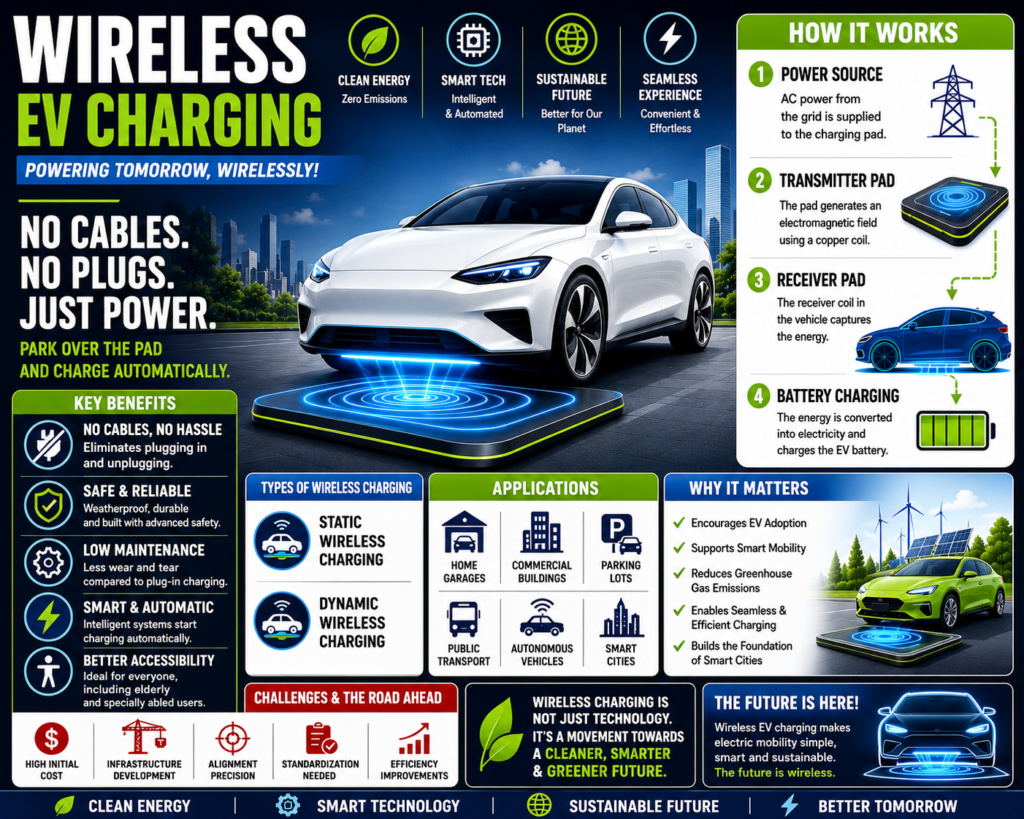
The electric vehicle industry is evolving rapidly, and one of the most exciting innovations is Wireless EV Charging. Traditional EV charging requires drivers to connect charging cables manually. Wireless charging eliminates the need for plugs and cables by transferring energy through electromagnetic fields.
As electric vehicle adoption grows worldwide, convenience becomes increasingly important. Wireless EV charging promises a future where drivers simply park their vehicles over a charging pad and charging begins automatically.
What is Wireless EV Charging?
Wireless EV Charging, also known as Inductive Charging, is a technology that allows electric vehicles to charge without physical cables. The system uses electromagnetic induction to transfer energy from a charging pad installed on the ground to a receiver installed in the vehicle.
The process is similar to wireless smartphone charging but on a much larger scale. A charging pad generates a magnetic field that transfers energy to the vehicle’s receiving coil, converting it into electricity to charge the battery.
How Wireless EV Charging Works
The technology relies on electromagnetic induction and consists of two major components:
- Ground Charging Pad (Transmitter)
- Vehicle Receiver Pad
When alternating current passes through the transmitter coil, it creates a magnetic field. The receiver coil captures this magnetic field and converts it back into electrical energy to charge the EV battery.
The charging process typically follows these steps:
- Vehicle parks above the charging pad.
- System detects vehicle alignment.
- Magnetic field is generated.
- Energy transfers wirelessly.
- Battery charging begins automatically.
Types of Wireless EV Charging
1. Static Wireless Charging
Static charging occurs when the vehicle remains parked over a charging pad. This is currently the most common wireless EV charging method.
2. Dynamic Wireless Charging
Dynamic charging allows EVs to charge while driving. Charging coils are embedded beneath roads, continuously transferring energy to moving vehicles.
This technology could significantly reduce battery size requirements and extend vehicle range.
Advantages of Wireless EV Charging
- Maximum convenience for drivers.
- No physical charging cables.
- Reduced wear and tear.
- Improved user experience.
- Weather-resistant charging.
- Supports autonomous vehicles.
- Enhanced accessibility.
- Smart charging integration.
Wireless Charging vs Traditional Charging
| Feature | Wireless Charging | Plug-in Charging |
|---|---|---|
| Convenience | Very High | Moderate |
| Cable Required | No | Yes |
| Automation | Fully Automatic | Manual Connection |
| Maintenance | Lower | Higher |
| User Experience | Excellent | Good |
| Initial Cost | Higher | Lower |
Applications of Wireless EV Charging
Wireless charging can be implemented in various environments:
- Residential homes
- Office parking areas
- Commercial buildings
- Shopping centers
- Airports
- Bus depots
- Taxi stations
- Autonomous vehicle fleets
- Smart city infrastructure
Wireless Charging for Autonomous Vehicles
Autonomous vehicles require automated charging solutions. Wireless EV charging perfectly complements self-driving technology because vehicles can recharge themselves without human intervention.
Future robotaxis and autonomous delivery vehicles may operate continuously using automated wireless charging stations.
Challenges Facing Wireless EV Charging
Despite its benefits, several challenges remain:
- Higher installation costs.
- Infrastructure development requirements.
- Alignment precision issues.
- Standardization challenges.
- Energy transfer efficiency concerns.
- Limited public charging availability.
However, ongoing research continues to improve efficiency and reduce costs.
Energy Efficiency Considerations
Modern wireless charging systems can achieve efficiency levels close to traditional wired charging systems. Advanced alignment systems and improved magnetic resonance technologies are helping minimize energy losses.
Many next-generation wireless charging systems now exceed 90% efficiency under optimal conditions.
Role in Smart Cities
Smart cities aim to integrate connected technologies that improve urban living. Wireless EV charging can become a key component of smart transportation infrastructure.
Future parking spaces may include embedded charging pads that automatically charge vehicles whenever they are parked.
Public roads equipped with dynamic wireless charging systems may further reduce range anxiety among EV owners.
Environmental Benefits
- Encourages EV adoption.
- Supports renewable energy integration.
- Reduces greenhouse gas emissions.
- Improves urban air quality.
- Promotes sustainable transportation.
As renewable electricity generation increases, wireless charging will contribute to cleaner transportation systems worldwide.
Future Trends in Wireless EV Charging
The future of wireless EV charging looks highly promising. Several emerging trends include:
- AI-powered charging optimization.
- Vehicle-to-grid integration.
- Smart energy management.
- Dynamic charging highways.
- Autonomous charging networks.
- Ultra-high efficiency charging pads.
- Renewable-powered charging systems.
Governments, automakers, and technology companies are investing heavily in advanced charging infrastructure to support growing EV adoption.
Market Growth Potential
The global wireless EV charging market is expected to experience rapid growth throughout the next decade. Increasing electric vehicle sales, government incentives, and advancements in charging technology are driving demand.
Major automotive manufacturers are already testing wireless charging solutions for future vehicle models.
Conclusion
Wireless EV Charging represents one of the most exciting advancements in electric mobility. By eliminating cables and creating a seamless charging experience, this technology has the potential to transform how electric vehicles are powered.
Although challenges such as infrastructure costs and standardization remain, continuous innovation is accelerating adoption. As smart cities, autonomous vehicles, and renewable energy systems become more widespread, wireless EV charging is expected to play a crucial role in the future transportation ecosystem.
For EV owners, businesses, and city planners, wireless charging offers a glimpse into a future where charging becomes effortless, automatic, and fully integrated into everyday life.